


A box of donuts that Joanna Vervoza-Dolezal, the starting centre back for TSS Rovers, brought for the Swanguardians on the last game of the season. Reciprocity in support.
Yesterday I had an informal call with a person who is leading up customer relationships for a large local company. The company is both a profit-making venture but also is a community institution and has a profile and responsibility beyond just the bottom line. We were talking about how the organization was stuck and the different approaches that the organization was taking towards customer relations when we stumbled onto an untapped area that may help to get the organization unstuck.
For organizations with double or triple bottom lines, the moment your focus moves beyond a financial return on investment, your customers and clients stop becoming ATMs and start becoming friends. Yes. Friends. The lines between your organizational life and the community become blurred. Social license becomes a reality, and that means that customers suddenly make decisions out of love and loyalty to the bigger vision which they can help co-create. They become non-material investors and shareholders in what you are doing. Your sustainability does not solely rely on making a profit. It relies on how those people that buy your services AND how they help shape and co-create your mission.
Where we got to in this conversation was that the organization needed to find ways to allow customers and clients to offer something back. Rather than going out and catering to their needs constantly and trying traditional marketing methods of giving the illusion of being a part of something, customers and clients of the organization need to have a chance to be meaningfully involved. In fact there are probably at present lots of people who are trying to give back and be involved but haven’t been seen because the organization has no way to receive their gifts. This is a real shift for how this organization has grown to see its customers. As the connection to social license fades away, customers increasingly get seen as people to be catered to, responded to and served. On the surface that seems a noble customer relations strategy, but when challenges are met, there are very few people with a meaningful investment in the organization to help repair it and set it back on track. Customers can just walk away at any time. And if you have customers who have bought into the social bottom line but you are only chasing the dollar, those ones will feel the lack of reciprocity first. When they leave its hard to get them back.
Why? Because people want to give. They want to be a part of something. They want to do something meaningful with their lives, their time and their money. We love a good product, but we also crave being a part of making it. Witness the way Apple for example has created a Distinguished Educator network. This is a way that educators in schools who love Apple products can help create new applications for these products in their schools. These folks are often cutting edge front-line teachers who are exploring pedagogy and using technology in a way that supports good learning theory. They are no longer customers. They are helping the company grow its brand, for sure, by working with schools but they also helping Apple find new ways to use their technology in service of education and learning.
As the Chair of the Board of Rivendell, a non-profit spiritual retreat centre, we’ve been exploring this angle through fundraising. We are an organization that has been generously supported by a Foundation throughout our whole existence and we have decided that we want to start doing fundraising not because we need financial resources, but because we want to create a different relationship with the community of people who love and support us and for whom our organization has made a deep impact in their lives. None of us on the Board are skilled at fundraising, and for all of us the prospect of doing it is terrifying. So we decided to learn together. We worked with a friend of mine who specializes in fundraising in these kinds of situations and he said his job is not parting people from their money but rather “helping people with money them heal by giving them a way to make meaning.”
Heal from what? Partly from a world that has completely commodified us either as a customer or as a unit of productivity. I think humans have a deep need to give and to be a part of something, but those of us who live in capitalist market-based societies are primarily valued as transactions. Everything we do is tracked for the benefit of dominating our attention and ultimately our wallets. But when I am offered an opportunity to provide a gift of time or money because it enters me into reciprocity and relationship, suddenly my life has the meaning I have been seeking. It is truly healing to give a gift and have that gift received.
To refuse an authentic gift is dehumanizing to both the giver and the receiver. Over time, losing the opportunities to provide gifts causes us to lose touch with what fundamentally makes community.
You cannot build communities around transactions. If your organization has a social bottom line at all and your entire customer relations strategy is transactional, I reckon you will always fail on this score. I think many companies who start out with a social bottom line leave it behind if they can’t figure out how to do it and revert to the single financial bottom line. That is enabled with customer management systems and managers who are trained in this type of work. Through our Art of Participatory Leadership training, we seek to teach leadership practices that enable social sustainability through enabling contribution. I’d love to know if folks are seeing this meaningfully taught in MBA programs or inside other institutional management and business programs.
The sustainability of an enterprise with an implicit or explicit community mandate rests in the ability of the enterprise to create spaces for people to give and co-create. That leads to co-ownership which can be material – like with our TSS Rovers FC community-ownership model – or more intangible, like the feeling of connection people have to helping create a space for spiritual renewal at our Rivendell retreat centre. Our sustainability depends on financial security and community. TSS Rovers FC needs to make a profit to survive, but we cannot do that without a community of people investing their time and talent over the long term to create an organization that is about developing humans, whether on or off the pitch. We encourage folks to offer what they can to the enterprise with two principles:
- Assume your talents are needed and;
- Proceed until apprehended.
The result at Rovers is that we have a happy patchwork of folks who offer expertise, enthusiasm, money and sometimes just an extra body to move things around. We even have a tradition of our players helping to set up the stadium and prepare the supporters section before they begin their warm up routines. We try to provide opportunities for everyone to experience gifting, because that is fundamental to the game of football anyway. Giving, receiving, offering space and time, and enabling your team mates to succeed is what secure victory on a football pitch and so we try to bring that ethos into our lives off the field too. That is how we go from being a successful football club to being a place that makes better humans and builds community whether you come to a match, in cleats, boots, shoes, sandals or bare feet.
Think about that. In the place where you are involved as a formal or informal leader, how are you enabling people to give? How are you receiving and holding the gifts and intentions of those in your orbit who are already giving to you? How are you enabling reciprocity to build community and sustainability?

Smelhmelhélch (Passage Island) at the mouth of Átl’ka7tsem (Howe Sound) before the snows came earlier this week.
Some notes on 2023 while I have a moment to review them.
The year began with the death of my father and is ending with worries about the serious and lingering health issues of other senior family members and so in a lot of ways this year has been split between personal grief during the first part of the year, and the waiting, supporting and attending in the second part of the year. Several times during the year, I haven’t found myself at my best. And that’s added on top of the persistent and low level background radiation that comes from the feeling that the world is slowly coming apart on this part of the planet and we are collectively ill-equipped to deal with it.
It hasn’t left me pessimistic, but I have noticed that I’m sad at what we have lost, which most of all appears to be the collective capacity to DO SOMETHING about the long term prospects for our planet and the community of living things that occupy it. as irrational as that thought is, because truthfully, it has been that way for my whole life, nevertheless, there is a feeling of loss. I’ve always described myself as an optimist because I believe that there is always something better we can do or embody, but the general prognosis needs power and wealth to radically change directions, and increasingly, I’m not confident that will happen. And so we push on.
Work
My work is changing, and has done throughout the pandemic. In the past I did much more face to face and one off facilitation work and delivered teaching through Art of Hosting workshops, for which I travelled the world. As I get older, I am more interested in teaching and supporting younger facilitators and so there is much more teaching now and one-to-one coaching and we are also taking work that is larger in scope than facilitating single meetings, in which we are focused on longer term support for leaders and organizations who want to be more participatory and more engaged with meaningful work. I like this as it means we develop longer term relationships with a few clients and are able to see the results of our work together over time. Additionally most of this work continues to be online, which suits me well as I have become more of a homebody and more introverted in the last three years. I do love face to face work, but as I get older I find it much more tiring, and I appreciate the ability to deliver quality content to folks and then turn off my computer and go to the garden or play guitar for an hour.
In 2023 I will turn 55 and I have a strong commitment that on my 55 birthday we will begin the process to scaling back and only working four days a week. We have been planning on this for a while, and I’m really looking forward to this shift. I feel like I need it for all kinds of reasons. In my calendar starting June 13, every Friday for the rest of my life has a recurring event that says “Fridays off for the rest of my life.”
This year Harvest Moon which consists of Caitlin Frost and myself along with our stellar assistant Laura O’Neil, had 27 clients. Many of these were larger projects working within large organizations and involving a lot of teaching and capacity building to support leadership and organizational change. We do this with a set of tools and practices that include participatory facilitation methods from Art of Hosting, Dialogic Organizational Development approaches, Participatory Narrative Inquiry, complexity work and personal practices for rigorous inquiry on limiting beliefs. This year we packaged these into bespoke programs in complexity focused participatory leadership for the Executive levels and senior leadership of a major university, a Crown corporation, an Indigenous government, a national labour union and one or two smaller organizations. We embedded several three day Art of Hosting/Art of Participatory Leadership workshops in these settings, and also used our course material we have been developing around complexity and personal leadership practices to complement the strategic conversations that we hosted. We have written four extensive workbooks for these programs and this might well turn into something more formal in the years ahead.
We amplified all of this work with story collections primarily using NarraFirma to gather stories and PNI to design sense-making and strategic interventions. This last capacity has become key to our work now and I have now run upwards of 30 story collection and sense-making projects through NarraFirma since the pandemic began. Although we have become really good at working with this material online, this work is most powerful in person, and it is one of the things I am looking forward to doing more face to face.
Partners
Over the past year we have worked with many partners and it is my usual practice to name them. They live in five different countries (Canada, USA, Netherlands, Moldova and Australia) and working with them makes it possible for all of us to do amazing work together. My gratitude to them all.
- Harvest Moon partners Caitlin Frost and Laura O’Neil
- Tatiana Glad
- Meribeth Deen
- Bhav Patel
- Kris Archie
- Kelly Foxcroft Poirier
- Tiaré Jung
- Amy Lenzo and Rowen Simonsen at Beehive Productions
- Phill Cass
- Ciaran Camman
- Amanda Fenton
- Quin Buck
- Corrina Keeling
- Jodi Sanford
- Kinwa Bluesky
- Chad Foulks
- Geoff Brown
- Teresa Posakony.
Teaching
This year I offered several open enrolment courses with colleagues.
- Hosting Powerful Conversations: Introduction to World Cafe and Open Space Technology through teh Centre for Dialogue at Simon Fraser University, a course I have offered annually since 2009.
- Complexity from the Inside Out. A course that Caitlin and I have put together and that combines our joint bodies of work assembled over the past 20 years of working with complex systems and challenges. We ran two cohorts in 2021.
- The Art of Hosting. Every year since 2004 we have offered this program on Bowen Island, and in 2020 we offered it online. After missing 2021, this past year we offered it in person in Vancouver with Kris Archie and Kelly Foxcroft-Poirier (who sadly couldn’t be with us for the actually program days). We’ll repeat that again in 2023.
- Kelly and I did do a course together though, which was really magic. Transforming Power, offered alongside our friends at Beehive Productions, used Nuu-Chah-Nulth lenses to look at the power we have and how we wield it. I loved this course.
- Also through Beehive I offer courses on Chaordic Design, Harvesting and Sense-making and Hosting in Complexity all of which are available to take on demand.
Learning
In addition to everything I learned from teaching these courses I also enrolled in two important programs myself to deepen my own practice.
- Weaving It In: Making evaluation part of your work. This was an inaugural offering from my close colleague Ciaran Camman and combined their decades of evaluation experience with solid complexity and participatory practice. A nice combination of theory and practice and experiential learning.
- Co-Resolve introduction to Deep Democracy with Camille Dumond and Sera Thompson. After about 20 years of Sera challenging me to become friends with conflict, I finally came to study with her and this was a great course. The biggest shift in me is seeing how my conflict-averse tendencies have shifted from conflict resolution to what I’m calling “conflict preservation.”
- This next year I have signed up for Cynthia Kurtz’s deep dive into Participatory Narrative Inquiry which is a 20 week long practicum during which my colleague Augusto Cuginotti and I will be running a PNI project with a client. I haven’t done any learning like this at this sort of scale since University. I’m looking forward to it.
Living on the web
My first website was a collaborative writing project with my old friend Chris Heald called Stereotype back in 1995. It was a proto-blog in the style of suck.com, which even 25 years later is a remarkable documentation of the shift of life from physical to online. So I’ve lived through a lot of iterations of web life. This past year I started a long wean away from the walled gardens of Facebook and Twitter and began writing again on my blog with more frequency. I started a Mastodon account and have used that as an opportunity to rethink how I have compartmentalized my life online to suit various audiences. For the most part I have maintained a professional kind of look here and on my @chriscorrigan twitter account and I have devoted hours and hours of time to soccer life through my @salishsea86 twitter account. That is all changing slowly. I maintain some twitter accounts for the supporters group of the soccer team I co-own, but otherwise, I think everything will eventually be centralized back here with micro-posts on Mastodon. I will republish links to these posts through Facebook, LinkedIn and twitter as usual.
I’m slightly looking at LinkedIn again as there is some interesting professional content there that used to be published on blogs, but as much as possible I am integrating interesting content into my feeds at NetNewsWire. That is where I will be doing most of my reading, as the endless scroll of twitter and facebook are no long giving much value and Instagram is useless for my life, other than keeping up with our footballers who are half my age who only post there!
Avocations
This year has had three big commitments outside of family and work. As a founding member of the TSS Rovers Supporters’ Trust, I have spent the year selling shares to 351 co-owners of Canada’s first community-owned semi-pro soccer team. We have done some remarkable things this year including winning a League Cup on the men’s side and qualifying us for Canada’s national championship, the Voyageurs Cup, which is, mindbogglingly, the pathway to the FIFA Club World Cup. We will play a meaningful match in the first round of that competition in April against a Canadian Premier League professional team and the only thing better than actually getting this far would be effecting a giant killing in April. It has bee a remarkable journey all it’s own.
Another responsibility that I have devoted myself too is chairing the Board of the Rivendell retreat centre, a contemplative centre on Bowen Island. We have come through a pandemic and stayed afloat and are now beginning to engage in active fundraising for our longer term sustainability. This role is part of the way I live out my contemplative spiritual practice alongside a commitment to leading worship once a month at our little United Church on Bowen Island. I love that job. It helps us to afford our part time Minister and I get to dive deep into topics and scripture readings that are close to my heart. Perhaps I’ll post my sermon notes here in the new year if that’s of interest to you.
Music is my love and my third commitment. I have been singing with a renaissance choir doing medieval liturgical music and madrigals and studying jazz guitar on my own. My guitar teacher sadly died in April, and I miss him dearly. We had only a few lessons this year as he grew sicker. Learning jazz alone with only you tube videos and fake books is incredibly hard but incredibly rewarding and I’m hoping this year I might be able to study with another teacher and finally get a chance to play with folks.
Life on an island
I have lived on Nexwlelexwm (Bowen Island) now for 21 years and seen many changes over that time. I have blogged about living here for most of that time. These days we are facing a huge population turnover and some rapid growth which has introduced lots of new folks to the place and radically changed the culture. Community events are returning which is essential if we are to repair the cohesion as a community that has been lost through the pandemic. I feel that we are fragmented in many ways, and we are being confronted with some very challenging situations including a ferry system that is crumbling under global staffing shortages, strains on our little island infrastructure, economic pressures from living in one of the most expensive places on earth with no level of government committed to radical change, tourism pressures and mindset that sees the places increasingly as an under served and under resourced suburb rather than a rural community. These changes have been steadily occurring over the past number of decades but social media and a lack of face to face contact has made them more pressing.
In the natural world, the big news is the tremendous numbers of humpback whales and orcas that have returned to our seas, and there are almost daily sightings of these mega-fauna. Ten years ago that was unimaginable. While that is happening, we have also witnessed some extreme weather, including long hot droughts in the summer which are the biggest threats to the place. Things change here and being grounded in place means that one can be a long-eyed witness of it all.
So that is the state of play on Christmas Eve 2023. At the end of a year in which I was not at my best, after three years of living in a strange new world, entering the half way point of my 50s. Thank you for sharing this year with me. Say hi. I hope we can cross paths next year.

In the Art of Hosting world we have a few shared core teachings that show up in nearly all the learning workshops that happen. At some point we talk about complexity – we usually explore the Chaordic Path as a simple introduction into complexity – and we always touch on the Four Fold Practice of the Art of Hosting.
Back in 2014 I was doing a project with the United Church of Canada looking at the different levels of their structure in British Columbia and imagining what they could also be. If there is one thing that Churches have consistently done from the beginning it is that they adopt new forms. At the moment the United Church, and many other mainline progressive Christian denominations, are going through a massive shift, probably the biggest one since the Reformation. And it’s affecting everything.
So as I was doing this consulting work I started meeting communities of people who were asking how could they live through these transitions. Not survive them necessarily, but go with the transformation that was happening. As a part of the work I was doing I started offering talks and workshops based in the Art of Hosting, but wrapped in the theology of the United Church, becasue it turns out that having a way to understand complexity and to host life community is both necessary in struggling churches AND is pretty much the basis of Christian practice.
Now for those who don’t know, the United Church of Canada is a progressive, liberal Protestant denomination committed to radical inclusion and social justice. I was raised in that Church and at one point had my heart set on becoming a minister in that Church. My own spiritual practice is grounded in contemplative Christianity and I am an active member of the Bowen Island United Church where I help lead worship and preach one Sunday a month so we can give our paid minister a break.
That is just context to help you understand the theology behind this talk.
This talk was a keynote for the Northern Presbytery of British Columbia annual meeting from 2014. That year the churches of northern BC were gathering in Prince George to be together and practice being a bigger community. They invited me to come and speak on the work I was doing around community building and I chose to share the Chaordic Path and the Four Fold Practice and I relished the chance to share these ideas using stories and teachings from scripture.
So if you work with Churches or Christian religious communities and you are interested in the way the Chaordic Path and the Four Fold Practice basically help us use the teachings of both the Hebrew Scriptures and the Gospel in practice to build community, click here and have a listen.

It’s been a fair few interesting weeks. A heavy work schedule with some important in person facilitations, combined with steady online work and teaching and an extended family health emergency is stretching our resources around here. So here’s a little news.
Social media rethink
On the social media front I’m still active on Twitter, and just waiting to see what happens there. But I have also opened a Mastodon account and I like it better. Twitter was created in an era where the speed and interaction and brevity of text messaging met blogging. Mastodon feels much more like blogging in that we all have accounts that hosted in different places and you can follow each other. it’s like Twitter meets blogging plus an RSS feed. Consider your friends’ Mastodon accounts as mini blogs rather than twitter accounts. At its best, Twitter is great for banter and conversation and has a feel of a transparent text conversation. But it’s under the control of a single unstable genius at the moment and demonstrating why we should not trust critical infrastructure to single individuals or companies. Musk is messing with Twitter as if someone got hold of the power grid and decided to create a whole new type of power generation by firing all the hydro dam technicians and trying to find nuclear scientists to keep the old system going and also get a new one up and running right away.
Twitter was robust. Robust things fail catastrophically. Musk is in danger of taking the compancecy dive into chaos from which return is neight guaranteed nor cheap.
So just stay here by subscribing to this blog’s RSS feed or subscribing by email over there on the right sidebar, or add me at Mastodon @chriscorrigan@mastdn.ca. I’m still on Facebook and LinkedIn but I don’t interact much in those places.
What I’m doing besides work
I might start sharing some different content here, and probably will do so as well at Mastodon too, so in addition to posts here on complexity and facilitation and working with groups, you might start seeing some stuff relating to other passions I am interested in. That includes building Canada’s first ever supporter owned semi-pro soccer team, TSS Rovers, who won a men’s championship in our fourth season and are on our way to play pro-teams in Canada’s national championship for the Voyageur’s Cup. If you are in Canada you can buy a share here and be a part of history. Our teams play in the third level of men’s soccer in Canada and the highest level of women’s soccer.
You may know I am a long time amateur musician and I sing and play liturgical music, folks songs, Irish music and popular music and I have started expanding my guitar chops by studying and learning jazz guitar over the past few years. That has married two passions – jazz and guitar – that I have kept separate for most of my life because the thought of getting them together was overwhelming. But I’m having the time of my life playing this music. Enjoy what I am enjoying. Here’s a Canadian guitarist I am studying, Reg Schwager and legendary bassist Don Thompson playing Everything Happens To Me.
So those are a couple of things that might seem to pop up here out of the blue.
Some cool stuff to share
Finally, I continue to read and earn about my professional craft and lately I have come across some hight quality recourses that I HAVE to share with you all:
- A snapshot of REOS’s scenario planning methodology recently used in Australia and Aotearoa to address future wildfire issues. With thanks to my mate Geoff Brown, a member of that team. It’s so good I’ve added it to the Facilitation Resources page.
- A toolkit for starting up communities of practice from my friend Nancy White, who is just the best there is at this stuff.
- A reader-focussed report assessment tool from Fresh Spectrum that will help you keep your audience in mind so that the reports you are writing get used. This is a great harvesting tool.
- A nice six step process for strategic planning from my Aussie Art of Hosting mates at the Jeder Institute.
- A for you theory-heads, a paper by Albert Linderman on Sense-making Methodologies and Ethnography published at the Spryng.io website. I’ve started in on some of Dervin’s work on this. It’s heavy going in a good way.
So there you go. What have you been up to?
One of the earliest maps I ever discovered in my facilitation career was Sam Kaner et al.’s Diamond of Participation. It has been a stalwart companion for more than 20 years in my work. It forms a key part of the way the Art of Hosting community talks about process architecture, usually referred to as “the breath of design,” owing to its pulsation between divergence and convergence.
I realize I don’t have much on the blog about this map. So I thought I’d share my summary of Kaner et al.’s seminal work, The Facilitator’s Guide to Participatory Decision Making. If you don’t yet own this book, buy it now. It is an essential resource for all facilitators.
The Diamond of Participation
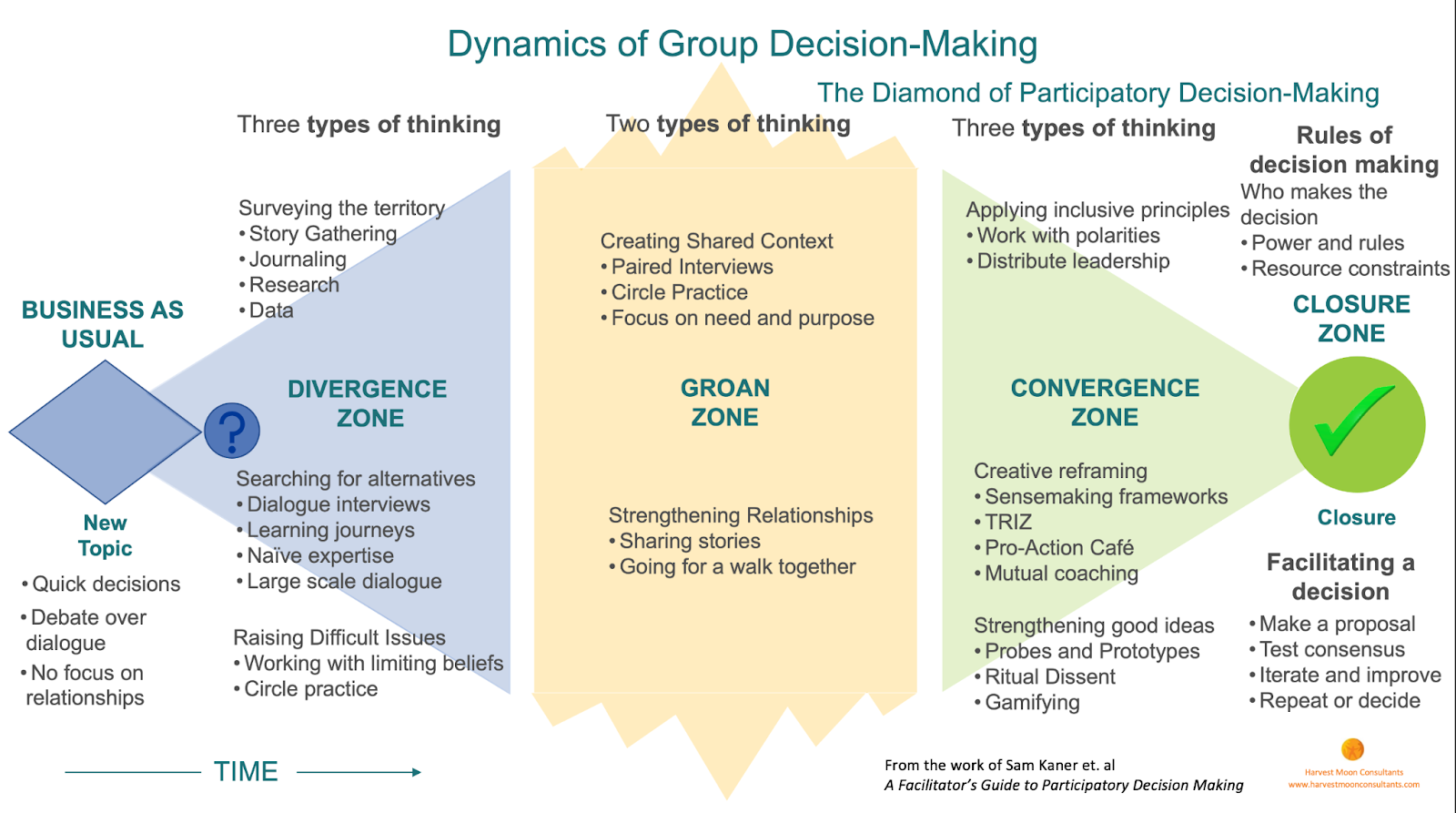
The Diamond of Participation is a map of the group process created by Sam Kaner and colleagues that identifies several phases a group goes through to create participatory decisions.
As groups engage with complex decisions, a very common journey goes through emotional and creative phases. Our ability to stay open to this journey enables us to discover new ideas, enter into the unknown, engage with difficult dynamics and make sustainable decisions. As a map, the diamond of participation helps us navigate the terrain of participatory decision-making and can help a group identify common traps, pitfalls and opportunities. Alongside personal leadership capacities to host and participate with presence and openness, this map, with tools and practices to help move through each stage, can support engaging, creative, participatory decision-making.
The diamond is divided into five zones or phases that groups go through. In each of these zones, leaders can help groups make good decisions by paying attention to the emotional terrain and using good tools at the right time.
Zone 1: “Business as usual”
Most decisions and conversations go quickly. You might need a few ideas and a couple of options, but the pathway is clear, and there is little or no controversy about what to do. Because we are conditioned to make decisions this way, it is common for groups to close a conversation down early, and for complex conversations this can have the effect of both avoiding conflict and limiting choices and possibilities.
When important decisions are on the table and there is no easy or obvious solution, groups enter the diamond of participation. Good leaders, with an awareness of the underlying patterns the diamond illustrates, can help guide a group through these stages toward more effective participatory decisions.
Business as usual involves:
- Quick decisions
- Debate over dialogue
- No focus on relationships
Zone 2: The Divergence Zone
Once it is clear that there is no obvious or clear decision, groups enter the Divergence zone. Familiar opinions get bandied back and forth and diverse perspectives on the problem begin to surface. This can be an enlivening time as a group searches for options and brainstorms possible paths forward. In the early stages of the divergence zone leaders can invite teams to explore different points of view and perspectives and introduce three key types of thinking: Surveying the territory, searching for alternatives and raising difficult issues.
Surveying the territory is done with methods that collect stories, perspectives and data and share them between the group members to build a shared picture of the diversity that the group is working with.
As a group searches for alternatives, holding intentional dialogue interviews, undertaking learning journeys or gathering stakeholders together can provide valuable information and insight.
But in truly complex processes, the answers are still not evident, and emotions can turn negative, with frustration and impatience beginning to appear. At this time, leaders need to be able to host the difficult conversations that come up so that diversity and difference don’t turn into unproductive conflict. In these moments, working with limiting beliefs and taking the time to sit in processes like circles and hear feelings and emotions becomes an important part of the work.
From this point, the group enters the Groan Zone, a sometimes painful part of the journey that can lead to fresh thinking and innovative decisions if it is well-hosted.
Zone 3: The Groan Zone
As a group enters the groan zone, people begin to struggle in the service of integration and in releasing their attachment to their own perspectives. Creating something new requires mixing, combining, and letting go. This can be a fraught experience rife with confusion, irritation, discouragement, anxiety, exasperation, pain, anger, and blame. It is no surprise that we want to avoid the groan zone, but for a group to discover new things, leaders can help people through the groan zone by engaging two types of thinking: creating shared context and strengthening relationships.
Creating shared context helps to re-ground a group in their work. This can take the form of paired interviews or group conversations where people explore different perspectives with a deliberate intention to listen for differences and where each other is coming from. Focusing on need and purpose can be valuable here as it gets a group “out of the weeds” and into remembering the deeper intention and the bigger picture.
Strengthening relationships is important in the groan zone, because frayed relationships will undermine the sustainability of a decision. Practices as simple as sharing stories, or going for a walk together can alleviate acute conflict and give people a chance to shift out of positions and reconnect to each other.
Work in the groan zone is heavily influenced by emotions and it is a lifelong practice for leaders to work on their own comfort and resourcefulness around conflict and strong emotions if they are to hold a group through this work.
Personal leadership practices are key to developing the ability to stay present and host process effectively in the groan zone. Developing deep self-awareness and presence, and using self-inquiry practices to shift reactive patterns can be helpful.
Zone 4: The Convergence Zone
When a group has worked through the groan zone, it comes time for convergence. This is where new ideas, fresh thinking and innovation can rise to the fore. The convergence zone precedes decision making as options are weighed, paths forward are discerned and, in larger processes, prototypes are designed for the purpose of testing new ideas.
When working towards a decision, three types of thinking are helpful: applying inclusive principles, creative reframing and strengthening good ideas.
Moving through the transition from groan zone to convergence requires a change in the container and the work. Inclusive solutions require a commitment to an inclusive decision making process, so it can be good practice to have the group design and adopt a set of inclusive principles to guide their work. These can be used later in the decision making phase as well.
Creative reframing invites the group to look at the work with new eyes. Having come through the groan zone together, all of the ideas that were gathered and discussed in the divergence zone take on new life. Looking at solutions with creative processes like scenario planning and TRIZ helps to introduce new ideas and perspectives to strengthen proposals.
And strengthening good ideas is the way towards making a sustainable agreement. Once ideas are contested, experimented with and considered it comes time to strengthen them through prototyping and piloting. The idea is to move the new ideas towards a decision by working with them through various scenarios first. Whatever can be done to strengthen an idea helps.
Zone 5: The Closure Zone
In participatory decision making processes closure usually involves making a decision together. This could be through a vote, or a consensus process, or it could even mean that the leader takes the decision alone with the consent of the group. Regardless of how closure comes about it is useful to agree together on the rules of decision making and then facilitate a decision.
Starting with agreeing on the rules and process gives you a chance to have a dry run through decision making with your group and this is especially useful if the decision you are making is contentious. Start by agreeing what would constitute a good decision and what a good, robust process is for making that decision. There are different versions of what consensus decision making can mean. You can research and try different approaches that best suit your context. For example, you may want to test consensus and have a rule that if someone is opposed to a proposal that they must bring an alternative to consider. You also might want to make some rules about timeliness of the decision or the maximum amount of resources available. When the group owns the process, it goes a long way to having them own the outcome.
Facilitating a decision can take various forms but typically goes through four stages: First, prepare a proposal that is simple and clear and that ensures that everyone knows what they are voting on. In some cases you might prepare two or three proposals in order to poll the group of options. Regardless, a proposal for a decision should be something taht is easily understood and easy to compare against other options.
Second, test the group for consensus. See who agrees with the proposal and who has questions or other things they would like to add. This process allows for a final set of conversations to strengthen the proposal. If you experience blocks and vetos at this stage of the process, this can give you good information about changes that need to be made or ongoing relationships that will need to be tended after the decision is made.
Third, iterate the proposal and review it again. Focusing on the major issues and questions means that the iteration process can be focused and aimed at creating a stronger proposal. Finally, make a final decision. That may be a vote or a consensus decision depending on what is required of the process.
Once the decision is made, the process is closed and the work continues. It can be important to give some thought to how the decision is communicated and implemented as part of your next steps.