

One of the earliest maps I ever discovered in my facilitation career was Sam Kaner et al.’s Diamond of Participation. It has been a stalwart companion for more than 20 years in my work. It forms a key part of the way the Art of Hosting community talks about process architecture, usually referred to as “the breath of design,” owing to its pulsation between divergence and convergence.
I realize I don’t have much on the blog about this map. So I thought I’d share my summary of Kaner et al.’s seminal work, The Facilitator’s Guide to Participatory Decision Making. If you don’t yet own this book, buy it now. It is an essential resource for all facilitators.
The Diamond of Participation
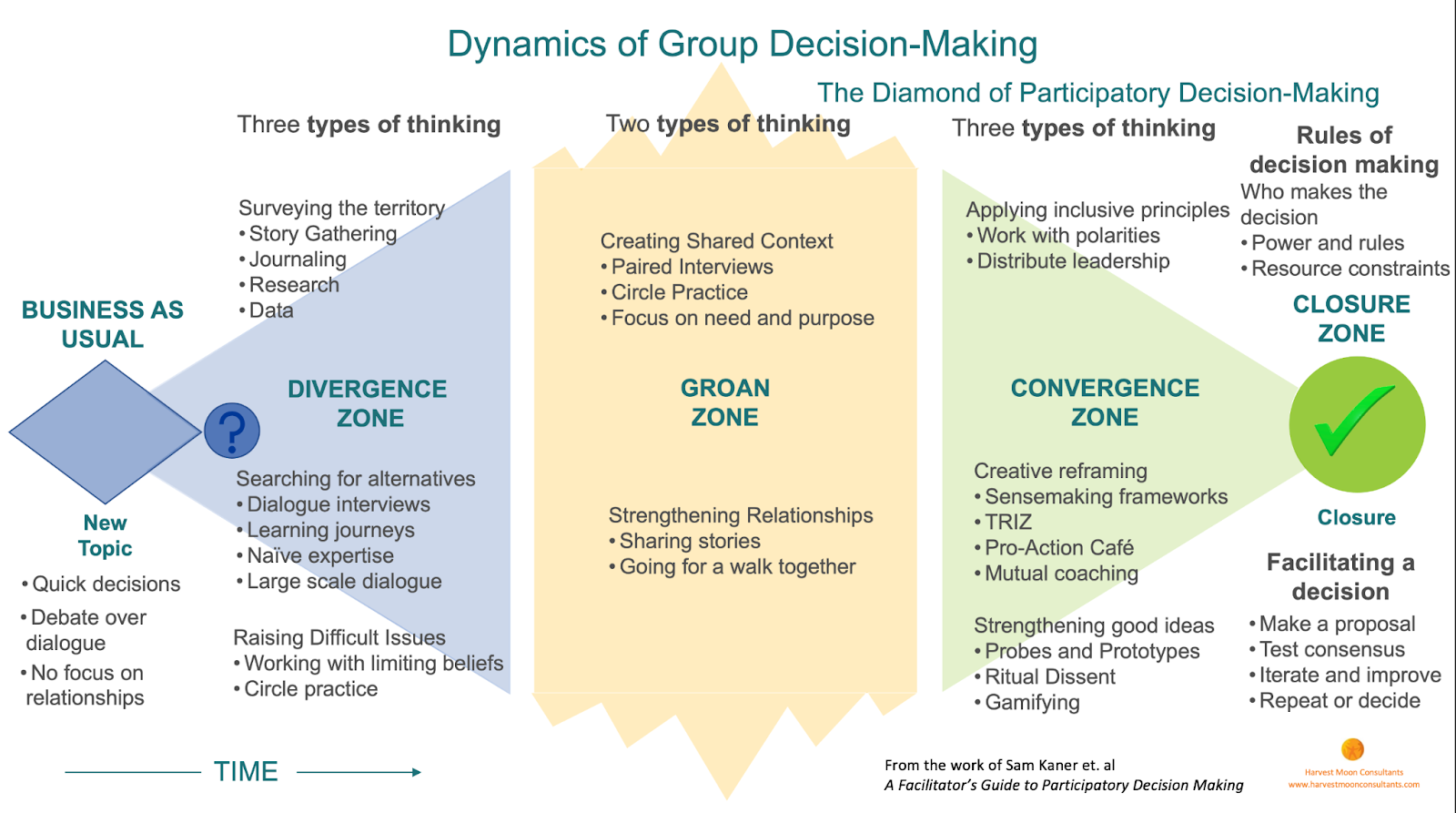
The Diamond of Participation is a map of the group process created by Sam Kaner and colleagues that identifies several phases a group goes through to create participatory decisions.
As groups engage with complex decisions, a very common journey goes through emotional and creative phases. Our ability to stay open to this journey enables us to discover new ideas, enter into the unknown, engage with difficult dynamics and make sustainable decisions. As a map, the diamond of participation helps us navigate the terrain of participatory decision-making and can help a group identify common traps, pitfalls and opportunities. Alongside personal leadership capacities to host and participate with presence and openness, this map, with tools and practices to help move through each stage, can support engaging, creative, participatory decision-making.
The diamond is divided into five zones or phases that groups go through. In each of these zones, leaders can help groups make good decisions by paying attention to the emotional terrain and using good tools at the right time.
Zone 1: “Business as usual”
Most decisions and conversations go quickly. You might need a few ideas and a couple of options, but the pathway is clear, and there is little or no controversy about what to do. Because we are conditioned to make decisions this way, it is common for groups to close a conversation down early, and for complex conversations this can have the effect of both avoiding conflict and limiting choices and possibilities.
When important decisions are on the table and there is no easy or obvious solution, groups enter the diamond of participation. Good leaders, with an awareness of the underlying patterns the diamond illustrates, can help guide a group through these stages toward more effective participatory decisions.
Business as usual involves:
- Quick decisions
- Debate over dialogue
- No focus on relationships
Zone 2: The Divergence Zone
Once it is clear that there is no obvious or clear decision, groups enter the Divergence zone. Familiar opinions get bandied back and forth and diverse perspectives on the problem begin to surface. This can be an enlivening time as a group searches for options and brainstorms possible paths forward. In the early stages of the divergence zone leaders can invite teams to explore different points of view and perspectives and introduce three key types of thinking: Surveying the territory, searching for alternatives and raising difficult issues.
Surveying the territory is done with methods that collect stories, perspectives and data and share them between the group members to build a shared picture of the diversity that the group is working with.
As a group searches for alternatives, holding intentional dialogue interviews, undertaking learning journeys or gathering stakeholders together can provide valuable information and insight.
But in truly complex processes, the answers are still not evident, and emotions can turn negative, with frustration and impatience beginning to appear. At this time, leaders need to be able to host the difficult conversations that come up so that diversity and difference don’t turn into unproductive conflict. In these moments, working with limiting beliefs and taking the time to sit in processes like circles and hear feelings and emotions becomes an important part of the work.
From this point, the group enters the Groan Zone, a sometimes painful part of the journey that can lead to fresh thinking and innovative decisions if it is well-hosted.
Zone 3: The Groan Zone
As a group enters the groan zone, people begin to struggle in the service of integration and in releasing their attachment to their own perspectives. Creating something new requires mixing, combining, and letting go. This can be a fraught experience rife with confusion, irritation, discouragement, anxiety, exasperation, pain, anger, and blame. It is no surprise that we want to avoid the groan zone, but for a group to discover new things, leaders can help people through the groan zone by engaging two types of thinking: creating shared context and strengthening relationships.
Creating shared context helps to re-ground a group in their work. This can take the form of paired interviews or group conversations where people explore different perspectives with a deliberate intention to listen for differences and where each other is coming from. Focusing on need and purpose can be valuable here as it gets a group “out of the weeds” and into remembering the deeper intention and the bigger picture.
Strengthening relationships is important in the groan zone, because frayed relationships will undermine the sustainability of a decision. Practices as simple as sharing stories, or going for a walk together can alleviate acute conflict and give people a chance to shift out of positions and reconnect to each other.
Work in the groan zone is heavily influenced by emotions and it is a lifelong practice for leaders to work on their own comfort and resourcefulness around conflict and strong emotions if they are to hold a group through this work.
Personal leadership practices are key to developing the ability to stay present and host process effectively in the groan zone. Developing deep self-awareness and presence, and using self-inquiry practices to shift reactive patterns can be helpful.
Zone 4: The Convergence Zone
When a group has worked through the groan zone, it comes time for convergence. This is where new ideas, fresh thinking and innovation can rise to the fore. The convergence zone precedes decision making as options are weighed, paths forward are discerned and, in larger processes, prototypes are designed for the purpose of testing new ideas.
When working towards a decision, three types of thinking are helpful: applying inclusive principles, creative reframing and strengthening good ideas.
Moving through the transition from groan zone to convergence requires a change in the container and the work. Inclusive solutions require a commitment to an inclusive decision making process, so it can be good practice to have the group design and adopt a set of inclusive principles to guide their work. These can be used later in the decision making phase as well.
Creative reframing invites the group to look at the work with new eyes. Having come through the groan zone together, all of the ideas that were gathered and discussed in the divergence zone take on new life. Looking at solutions with creative processes like scenario planning and TRIZ helps to introduce new ideas and perspectives to strengthen proposals.
And strengthening good ideas is the way towards making a sustainable agreement. Once ideas are contested, experimented with and considered it comes time to strengthen them through prototyping and piloting. The idea is to move the new ideas towards a decision by working with them through various scenarios first. Whatever can be done to strengthen an idea helps.
Zone 5: The Closure Zone
In participatory decision making processes closure usually involves making a decision together. This could be through a vote, or a consensus process, or it could even mean that the leader takes the decision alone with the consent of the group. Regardless of how closure comes about it is useful to agree together on the rules of decision making and then facilitate a decision.
Starting with agreeing on the rules and process gives you a chance to have a dry run through decision making with your group and this is especially useful if the decision you are making is contentious. Start by agreeing what would constitute a good decision and what a good, robust process is for making that decision. There are different versions of what consensus decision making can mean. You can research and try different approaches that best suit your context. For example, you may want to test consensus and have a rule that if someone is opposed to a proposal that they must bring an alternative to consider. You also might want to make some rules about timeliness of the decision or the maximum amount of resources available. When the group owns the process, it goes a long way to having them own the outcome.
Facilitating a decision can take various forms but typically goes through four stages: First, prepare a proposal that is simple and clear and that ensures that everyone knows what they are voting on. In some cases you might prepare two or three proposals in order to poll the group of options. Regardless, a proposal for a decision should be something taht is easily understood and easy to compare against other options.
Second, test the group for consensus. See who agrees with the proposal and who has questions or other things they would like to add. This process allows for a final set of conversations to strengthen the proposal. If you experience blocks and vetos at this stage of the process, this can give you good information about changes that need to be made or ongoing relationships that will need to be tended after the decision is made.
Third, iterate the proposal and review it again. Focusing on the major issues and questions means that the iteration process can be focused and aimed at creating a stronger proposal. Finally, make a final decision. That may be a vote or a consensus decision depending on what is required of the process.
Once the decision is made, the process is closed and the work continues. It can be important to give some thought to how the decision is communicated and implemented as part of your next steps.

I think I’m definitely feeling like my work is online for the foreseeable future. While I do have some face-to-face sessions lined up for the fall and winter, most of what I am going to continue to do is host meetings and learning online.
Even though I have been doing that since probably 2004 or so when I first started using Skype I continue to learn about how to make online environments more interesting and, most importantly, more accessible. From time to time I put out a call to help me learn about people’s needs and experiences. Back in June I asked folks with Attention Deficit Hyperactivity Disorder (ADHD) how to help them participate at their best and I got lots of useful answers. I trust that the people who answered self-identified as folks with ADHD.
Here’s what I learned:
Preparation
Right off the top folks said that it helps to have lots of advance notice of what is going to happen in the meeting. Now, this is a hard one for me, because I tend to improvise a lot and respond to the direction the group is going in. That’s fine for me because I’m the one with agency and I can control how much bandwidth I have and choose the stop the work for a break when it feels good to me. But for folks that regulate their participation and attention through structure and preparation that can be a tiring ride and quickly erodes their ability to absorb material, and participate in discussion. To that end, I’ll be trying these strategies:
- At the outset, let participants know how the day will unfold, what the break times are and what the discussion questions are likely to be. This helps people to think through material and to prepare and how to measure out their attention and participation.
- Help ground the meeting in a strong purpose. Let people know why this work is relevant to them. That helps folks stay engaged in the session. This is good invitation practice.
In-meeting participation
Working online is very hard on the attention span for most people. It asks a lot of us to stay in one place, watching a grid on a flat video screen, engaging in activities that seem repetitive. If something is going on too long, it’s easy for attention to wander and the brain to start focusing on other things. Good facilitation in general should be avoiding these situations, but for folks with ADHD, specifically these strategies were offered.
- In the session, provide a mix of activities to generate and support thinking. This could include a few minutes of silent reflection at the outset of a conversation so participants can think about the question before responding or engaging in dialogue and exploration.
- Present material in smaller chunks and allow for some time to absorb and for participants to ask themselves “what is new here?” Longer presentations start to lose the viewer especially if the material is dense or full of new terms and concepts. I’m massively guilty of this and so going forward I’m going to try to present material in short, ogical, connected chunks that allows for integration.
- For learning exercises, provide activities that invite people to explore a concept and even provide a little challenge that allows for a safe-to-fail probe and a little dopamine reward. This little post from Nadia is one that inspired “the creative challenge” as a part of my facilitation practice.
- Don’t allow a few people to go down rabbit holes at the expense of everyone else’s learning. This can often happen in a plenary session, so I try to have people go into small groups to process some of the things they are hearing and learning.
- Sticking to commitments is important. If there is a break at 10:30, break at 10:30. I know already from years of working with folks with diabetes that scheduled meal times are essential and can’t be missed. This is true of folks with ADHD as well.
- Provide visual maps for the content that is being discussed. How does this link to other stuff we have been doing? My partner Caitlin is really good at doing this, and contextualizing our current learning in a larger landscape of what we are doing. It’s like those recaps that come before TV episodes…”previously on Star Trek…”
- Use tools like polls to engage people’s thoughts in plenary and then open the floor for comments based on that. Using tools like Menti gives people a chance to reflect and offer some text and so you can hear from everyone and not just the one or two who manage to get their voices heard.
What to do afterwards
As my friend Christie Diamond reminded me years ago, “the conversations starts long before the meeting begins and it ends long after the meeting is over.” To that end, it’s helpful to have a few plans for how to continue to participate after the meeting is done. For many people, the brian keeps sparking and having somewhere to contribute insights that come later is helpful. To that end it’s useful to let participants know what they can do afterwards with their insights. If there is a way to contribute, provide an email address and let them know how long that channel is open for. In our courses we use Kajabi as a learning platform that allows for discussion to take place in a forum at a later date. For programs like Complexity From the Inside Out which runs over nine weeks, these spaces are useful for asynchronous contributions.
So those are good strategies to use. I myself have never been diagnosed with ADHD, but when I look at symptoms I recognize many of the ways my brain works in those lists. Certainly the suggestions that my twitter correspondants provided would make MY own participation work better. I will leave you with a good short list from the UK National Health Service that provides some useful strategies for living with ADHD, many of which are simply good design principles for well delivered and accessible participatory events in general.
Thanks to all who contributed. What OTHER strategies should we add?

Lots of good stuff coming through the pipe lately. Here are some links for your attention:
AI is running our lives and we need to find ways to deal with it.
- A conversation with LamDa, an artificial intelligence, and the implications of this transcript. The stuff seems like science fiction, but so much of our lives are starting to be mediated through AI bots. We are heading for a reckoning with our ethics, and I’m not entirely sure that the folks with their hands on the technology levers of power are equipped for the job. Make philosophy and ethics a required part of STEM curricula? Please?
- Perhaps as an antidote, or a vision of what could be, Harold has a nice piece about managing in complexity and the need for what he brilliantly calls “permanent skills.”
- And because Harold is such a must-read much of the time, here’s another piece on how he navigated information wars and expertise during the first two years of the pandemic. Paying attention to signals and having well curated streams for receiving good information is very very difficult, and not something that most of us have the time and experience to do. And so we are preyed upon by single viewpoints that have a lock on our dopamine production, feeding confirmation bias and disconnection. Harold’s writing, as always, seeks to bring the most brilliant human capacity of sensemaking into this work.
Being a better facilitator
- Nadia and Corinne remind us of the power of invitation. I have blogged about this stuff for decades, but I never tire of reading simple,well thought out pieces on this. Share them with your clients and groups you are working with, because they help to spark the conversation that will lead to designing good group process.
- Beth Cougler Blom dusts off her preparation protocol for in person meetings and finds that it needs an upgrade. Useful to me as I have been quite slow to return to in person work, and I’m mostly okay with that. So that means I need to be really conscious when preparing space for in person meetings, and reports from the front line are welcome!
Geek out on some sports and complexity theory
- Some of the most exciting work to me in applied complexity is happening in the sports world. This is a truly OUTSTANDING twitter thread from Phillip O Callaghan charting hours worth of reading on nonlinear pedagogy and constraints led approaches to sport, which has implications for all the ways in which we teach complexity in complex settings. Honestly, this is a course syllabus.
- Here is a really good piece on how the former Australian cricketer Greg Chapelle managed his cognitive load and attention to enable himself to make decisions in a environment that required both hear and wide situational awareness. Fascinating discussion on how we find strategies for managing ourselves in novel cognitive environments, and how so much of the tools we need are already available to us, to be exapted from other parts of our evolutionary journey.
And I leave you with a lovely quote shared by Euan:
[People] go abroad to wonder at the heights of mountains, at the huge waves of the sea, at the long courses of the rivers, at the vast compass of the ocean, at the circular motions of the stars, and they pass by themselves without wondering.
– St. Augustine
That’s probably enough for you to get stuck in for a few weeks.

Since 2004, the Art of Hosting has been offered every autumn on Bowen Island, British Columbia, where I live. I was a participant in the first one and since then have been on the hosting team every year. We love hosting people here, as the island itself is such an incredible place to be and to sink into relationship with one another as we learn and explore participatory leadership and facilitation. What I especially love about this offering is the people that we work withe on our teams and the questions we get to be in together.
In the past all of our retreats have been residential, and as we ease out of COVID restrictions we have decided that we want to offer an Art of Hosting in this region, but we’re not yet ready to make it residential. And so we are proud to announce that from September 26-28, 2022 to be held in Vancouver. You can register here.
Our team this year will consist of me, Caitlin Frost, Kelly Foxcroft-Poirier and Kris Archie. All four of us have stewarded the Art of Hosting in this region for many years working with Indigenous communities, non-profits, governments, philanthropy, and businesses in a huge variety of settings. We bring a deep set of experiences with the Art of Hosting,using the four fold practice in incredibly diverse contexts, working with participatory methods and leadership development with equity and decolonization lenses and putting the tools and practices to use in contexts ranging from personal work to system change around social services, mainstream philanthropy, and governance.
These three partners are some of my closest collaborators in this work and I think it is fair to say that we are all mutually inspired by each other. I am excited to see the growing list of people coming to join us for this event. The learning and creativity in the room will be amazing.
We would love to have you join us. Click the link to learn more about the program and please come and join us in Vancouver in the fall.

Im just coming back from a meeting this weekend on Vancouver Island where Kelly Poirier and I were working with some specialized health care workers who were meeting with Indigenous families around creating a care model for their children. We had three families with us including six children, two of which were babies, a five month old and a seven month old.
It has been a long time since I facilitated meetings with babies taking an active role in the proceedings. The children were included in this meeting as participants and they had as much to offer both the content and the process while also demonstrating what it looks like when we build a system with children at the centre.
With the world increasingly full of people that are acting like babies, it’s a good time to pause and reflect on the lessons that actual babies bring to the game. Babies get a bad rap.
The clock doesn’t matter. Rhythm matters. When there are babies in the room, we learn to pay attention to natural rhythms. Babies that are constantly held and cared for are very quiet and happy. The two babies we had in the room with us loved being held by others and they were looked after by their older siblings and other participants in the meeting. This of course is common in Indigenous families and large families. The babies had a blanket in the middle of the room they could roll around on and their every need was looked after. If they needed holding, they were picked up. If they needed as nap they could cuddle up with someone. If they needed feeding, they were fed, if they started getting tired at the end of the day, we closed the meeting down. If they were late in the morning, then we started once everyone was present and settled. Babies do not obey a clock, but they do very well at reminding us of healthy rhythms. Watching Kelly facilitate an hour of reflective practice with a five month old baby curled up in her arms sound asleep was beautiful.
Put the children in the centre not around the edges. We had babies in the middle and we had smaller children who were offered many options for being present including going in and out of the room, being accompanied by different adults and contributing. But there was no child care offered for our meeting. The meeting was child care and the children had a place in it. We all took turns being with the children, and they were never out of sight or out of earshot.
Babies change the conversation. The meeting we were running was not full of conflict or high emotions but it was about tricky issues like cultural safety and non-Indigenous professionals meeting with Indigenous families and so there was some nervousness in the room as we were building the container and the relationships. But babies make excellent talking pieces and excellent centres for a dialogue circle and having them constantly in our space made the conversation about them all the time. Their presence helped ground and simplify the conversation and it ensured that we spent our time well so as not to tire them out.
Babies have something to offer. Find a way to include them. Babies offer lots of things to a meeting, including feedback and insight and a kind of checking of the ego. All of the children in te meeting were included in every conversation sometimes in small groups, sometimes in the larger group. They offered their own answers to the questions we were asking because the questions were simple enough that a five year old could contribute “What do you like about your worker?” is a question everyone can answer and the children will often find ways to add to an adult’s story or tell it in their own voice. Additionally the two smaller children we had in our meeting were both excellent singers and when offered the chance to do so, they shared songs with us to end our meetings or bless the food, which is a common practice in Indigenous meetings on the west coast with adults usually offering songs before eating. There is nothing better than a child who loves singing being invited to share their gift with others in services of a genuine need rather than a cute performance.
Babies will tell you what’s happening in the room. Babies are very sensitive to the energy of a group. I learned this years ago, that they will sometimes express the emotions that are in a room in more subtle ways before the audults become aware. If things get tense they will get squirmy or begin crying from worry. It’s a signal to take it easy and take a little break. The baby is the first one to become unregulated in a setting and usually the first one to become regulated again. Babies don’t carry a lot of stories about what is happening in the room, so I pay close attention to their sounds and movements and it gives me information especially in setting like this one where the primary purpose was building a relational field and sharing and making sense of stories.
The baby reveals the truth of the system. If you are developing a model of care centered on children, watch what is actually happening with the children in the room. They way they are included and respected and lifted up so they contribute tells you a lot about how ready the people are to bring a truly child centered approach to their work. I have seen systems where the babies and the children gave us warning signs in the room that much more work had to be done. This weekend though was very special.