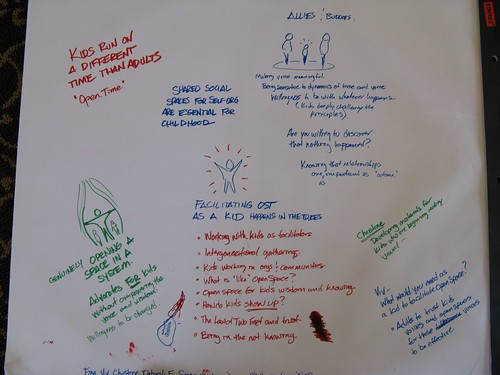
Yesterday I convened a session on our greatest “ahas” about the Open Space world over the last year…here is a selection from my report:
We discussed several things we have noticed over the past year or so that have been major “ahas” for us both as seasoned and new Open Space Technology facilitators. These insights fell into three broad categories.
First, it is clear that there is an increasing familiarity with OST and an increasing demand for the process. Furthermore it seems that groups that are using the process are going very deep and using it in very sophisticated ways. As facilitators we are finding less and less need to “sell” people on the idea of the process. This was attributed to a number of factors including the fact that society in general is learning and practicing a lot more of relationship working. Information technology has transformed to relationship technology and collaboration and interactivity has woven its way into many aspects of daily life. Mobility, interactivity, collaboration and tolerance for chaos have become more mainstream. As a result, we are learning more and more about the need to be more tolerant with chaos, as we have been perfected real time course corrections. Wikipedia is a mainstream example now of the power of collaborative technology and this has raised the bar for face to face meeting and collaborative work.
As facilitators we are learning more and more to be collaborative in all stages of the Open Space process, from invitation, to hosting, to harvesting and sustaining results. We are becoming more and more comfortable with the role of creating difficulty and chaos in order to help groups and organizations find new levels of innovation and collaboration. More of us are finding ourselves playing the archetypal role of The Fool in our work.
A third and very interesting development is noting the mental health benefits of participants experiencing greater integration as a result of being in active community experiences. Open Space seems to not only produce high quality results but also high quality relationships that results in deeper and deeper ways of being and deeper experiences of individual and collective wholeness.